Monthly Archives: October 2021

Fragile Flexibility (EF Skills Series)

In young children, the schema of their quality world usually revolves around a caregiver or a person who they consider as important in the development of their identity. Their interests initially mimic from imagining that they are versions of the adults they are surrounded by until they are exposed to wider environments, peers, language, media, and then a wholistic interest database emerges from the conglomeration and exposure.

It also makes sense that the younger the child, the more questions they ask. Rarely would you find a child between the ages of 3-5 years come into contact with adults who have set values or biases of themselves concerning what’s ‘right’ or ‘wrong’ around the way they perceive the world. This type of mental flexibility, of mixing and matching new, or new-old ideas in their youth is also directly proportional to the physical activity that they engage in. The pushing of limits of their physical capacities around places that are close to the natural world like garden parks, or places that have been landscaped for the socialization of little people like urban parks are indicators of their levels of mindful curiosity.

It certainly becomes less correlational when children become older, the degree or type of questions with physical movement. The overt questions may turn into musings and conformity is usually expected when school-age commences. Physical movement is timed if the child is not involved in organized sports or games. Just the same, however, the degree of flexibility in these minds depends on the environment they take in, and the imagination that is left from viewing the world from their youth. Martinez and Riba’s 2021 study, Cognitive Flexibility in Schoolchild Through the Graphic Representation of Movement postulates that Neuroconstructivism is the progressive complexity of mental representation over the course of cognitive development and the role of the graphic representation of movement in the transformation of mental schemas, cognitive flexibility, and representational complexity.

They also discuss that In this differential trajectory, mental representation is a key element for cognitive development and for understanding the emergence of child drawing, and changes thereof, as a graphic representation of internalized models of reality (Sirois et al., 2008). A child’s drawing is the first marker that enables the study of mental representation as an external manifestation of internalized reality, by showing what is known about it.

Moreover, events are naturally more attractive than objects, and their foremost feature is their movement. Therefore, part of the content of the first mental representations turns around the identity of events, objects, and people, and their movement and position, which forms the basis of the dynamic representations produced. The first external representative manifestation is the child’s scribble, in which the action of the drawing already contains expressive and representational meanings relating to shapes, movements, and emotions (Quaglia et al., 2015), even if there is no real figure that relates to a meaningful movement for representational purpose.

Such cognitive flexibility is what drives competition in a crowd. The narratives that may have been handed down from authority figures that were used to set ‘safety’ limits, such as limiting or eliminating outdoor time due to the location of where the child resides, or in this recent case the pandemic, inadvertently have pared down the curiosity factor toward the external influences. Subsitutions by devices and programs on the web were meant to digitize the parallel experience of the world beyond the home, however, without the multisensorial inundation of an experience, the ideas being written are almost dream-like. They may be able to describe a forest of trees in a contextual litany of facts, but ask them about the experience and then they are puzzled.

So do you make up for lost cognitive flexibility time for children? Or for yourself as a person of structure and routine? The answer is no. It is more important to make active choices to be exposed to the internal and external worlds that are immediate and to ensure that physical movements are consciously added in a 24 hour period than to make up for the over a year of standing still. Scientific studies have isolated the executive functions that aim at cognitive flexibility, which include the abilities to shift one’s thinking (flexibility), updating the learning that has been made based on the thinking shift (working memory), and response inhibition. In Uddin’s 2021 study, Cognitive and behavioural flexibility: neural mechanisms and clinical considerations she explains the core processes in thinking flexibility with this figure:
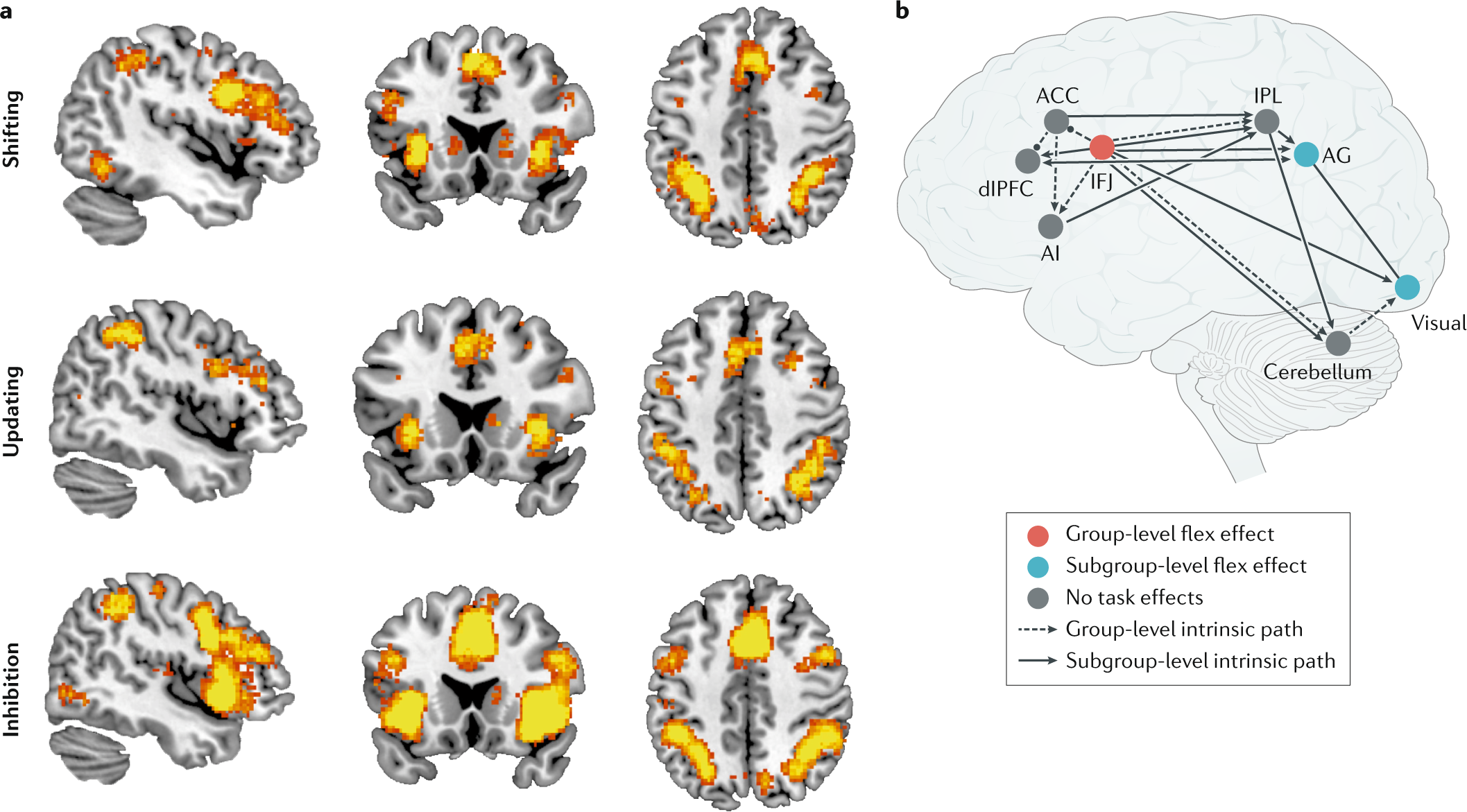
Fig. 1

Fig. 1: Core cognitive processes and brain network interactions underlying flexibility in the human brain. From: Cognitive and behavioural flexibility: neural mechanisms and clinical considerations

These brain maps were established with the use of automated meta-analyses of published functional neuroimaging studies can be conducted with Neurosynth, a Web-based platform that uses text mining to extract activation coordinates from studies reporting on a specific psychological term of interest and machine learning to estimate the likelihood that activation maps are associated with specific psychological terms, thus creating a mapping between neural and cognitive states. In the study, Neurosynth reveals that brain imaging studies including the terms ‘shifting’, ‘updating’ and ‘inhibition’ report highly overlapping patterns of activation in lateral frontoparietal and mid-cingulo-insular brain regions, underscoring the difficulty of isolating the construct of flexibility from associated executive functions.

This means that cognitive flexibility is an activity that requires the whole brain, and if that is the case, then it requires a complete human experience. In an article by Sahakian, et. al in the World Economic Forum site called, Why is cognitive flexibility important and how can you improve it? they indicate that Cognitive flexibility provides us with the ability to see that what we are doing is not leading to success and to make the appropriate changes to achieve it. Flexible thinking is key to creativity – in other words, the ability to think of new ideas, make novel connections between ideas, and make new inventions. It also supports academic and work skills such as problem-solving.

They also write that cognitive flexibility can also help protect against a number of biases, such as confirmation bias. That’s because people who are cognitively flexible are better at recognizing potential faults and difficulties in themselves and using strategies to overcome these faults. See their table below showing the flexibility representations:

How do we become adept at choosing to be flexible especially in situations that give little determination of what we can control? Aside from practicing the principles of evidence-based psychological therapy which allows people to change their patterns of thoughts and behavior (Cognitive Behavioral Therapy or CBT), Structure learning has been proven to be potentially another way. It has been described as a person’s ability to extract information about the structure of a complex environment and then decipher initially incomprehensible streams of sensory information via the process of elimination. This specific type of learning taps into the similar frontal and striatal brain regions as cognitive flexibility, thus exposure and practice are the keys to successful learning.

Go forth, be human, and explore!

Response Inhibition in the 21st Century (EF Skills Series)

If there is a human condition that is written most about second to human emotions, it would be that of impulse. Motivation powered by Dopamine and sped by Acetylcholine (AcH) is not necessarily supported by the higher-order skills that the Frontal Cortex is known for when impulse gets in the way. For example, when a choice is made by a person to eat what is body assistive or eat what is fast and palatable, chances are impulses drive the attention toward the sensory appealing choice.

It is by responding with delayed gratification, to not take the most convenient method to an end goal, that we can assess the process of each step toward the goal. How then can pacing be valued equitably when it is the efficiency of speed and productivity that pays higher dividends? What was pioneered by the Marshmallow test conducted by Walter Mischel in 1972 on preschoolers continues to be replicated, and bottom-line conclusions are the better a person redirects and controls his or her impulses, the clearer the direction of the path toward the end goal/s. Though not entirely specified, the original test was an exercise of concretizing “waiting” into something that had a “reward” in the end, and that the Marshmallow itself was not the real goal.

The ultimate reward of response inhibition is to process the game of waiting. Waiting on public transportation with a throng of people. Waiting and completing the morning routine despite sleep deprivation. Sticking to the regimen that is pro-health (physical, mental, emotional). To play the game of waiting efficiently, strategies that are at the person’s disposal are in the Inhibitory control toolkit, including scenario playing such as Stimulus–Stimulus- and Stimulus–Response-conflict with the many selves and environments a person interacts with.

The Waiting Game can be very difficult for those who have challenges attending to simple steps. The hippocampus is unable to maintain bridges with the Pre-Frontal Cortex (PFC) when the thoughts are not in sync, where working memory is affected since inhibiting responses allow memories to be processed clearly. Mindfulness exercises do increase the strengthening of neural pathways from the parietal cortex to the frontal cortex as it supports the just ‘being’ state without conclusions. However, as with attention, mindfulness requires a push-pull of one’s attentional inhibition, which means the decision to let some things just pass by like clouds while maintaining focus on the journey of the mind during the session is multilayered. Do I respond to the thought cloud of the ding of the phone, maybe that was an email…or do I cut this short, dinner time is close and I have friends coming later…wait, what was I supposed to be concentrating on…?

The yin-yang of inhibitory control behavior has many names in the field of behavioral science. Response Inhibition is also referred to as ‘Behavioral Inhibition,’ ‘Motor Inhibition,’ ‘Prepotent Response Inhibition,’ and ‘(Attention) Restraint’; while Attentional Inhibition is also referred to as ‘Interference Control,’ ‘Interference Suppression,’ ‘Resistance to (Distracter) Interference,’ and ‘Attention Constraint.’ Think of the two as the demonstration of Newton’s third law is: For every action, there is an equal and opposite reaction. This means response and attention in every interaction are the pair of forces acting on the two interacting choice objects.

Both these inhibition rubrics are necessary when interacting with general life situations that require working memory (both in verbal and auditory means), visual memory (stop and analyze then respond), reflexive responses (go/no-go tasks and responses), word spatial recognition, and figure grounding contrast and comparative analysis. In short, in every single aspect of living that requires a decision between options, it is the brain’s processes that attach to memories and emotions that decide between the choice to stay the course and inhibit or choose the one that interferes with the course and give in to the attentional distracter.

According to Verbruggen, et al (2014) in their study, The Inhibitory Control Reflex, performance in response inhibition paradigms can be modeled as an independent “horse race” between a go process, which is triggered by the presentation of a go stimulus, and a stop process, which is triggered by the presentation of the no-go stimulus or the stop signal. When the stop process finishes before the go process, response inhibition is successful and no response is emitted (signal-inhibit); when the go process finishes before the stop process, response inhibition is unsuccessful and the response is incorrectly emitted (signal-respond). The latency of the stop process (stop-signal reaction time or SSRT) is covert, but it can be estimated in the stop-signal task. SSRT has proven to be an important measure of the cognitive control processes that are involved in stopping.

Yet it is the weight of the end goal that determines the type of inhibitory control that one ultimately uses more of. And as mentioned earlier, the more concrete the process of inhibition by the fruition of an actual marked goal, the more likely one stays the course and avoids attentional constraints. In order to facilitate goal-directed behavior, the proper motor actions in a given context need to be selected and then executed. Regions within the medial wall of the
frontal cortex, in particular, the supplementary motor area (SMA), have been implicated in response preparation, selection, and execution. Single-cell recordings in monkeys performing a delayed reaction task reveal a distinction between the rostral portion of the SMA (‘‘pre-SMA’’) and the caudal portion of the SMA (‘‘SMA proper’’); neuronal activity is seen in the SMA proper only during the response; activity in the pre-SMA, however, is associated with both the delay period and the response, suggesting that the pre-SMA is involved in both preparation and selection of the response. This means that inhibitory responses are best strengthened when paired with a visual spatial or perceptual motor component prior to perceiving and selecting what the response selection is.

This could also support the idea that the younger the developmental age, the more multi-modal means are necessary to train the inhibitory models of the PFC. Competing with the gadgets that provide instant gratification however is much more prevalent since coming out of the lockdown, making the responses less precise and more impatient. Also part of the multi-modal means is to create a fruitful digital diet, one that is realistic and supportive of the ‘school or home work’ that still needs to be done in the platform while being able to segregate the ‘fun work’ that is embedded in the devices. One possibility is that increased functional segregation of neural networks during development results in greater differentiation of individual inhibitory control mechanisms at the behavioral level. Evidence for this is suggested by findings from the study done by Mostofsky, et. al (May 2021) Response Inhibition and Response Selection: Two Sides of the Same Coin) have found that tasks related to executive control tend to coalesce as a single factor in young children, but form a multi-factor construct in adults. This does not mean however that the addictive properties of smart devices do not affect adults the way they do children; response inhibition is key for moderation and for caudate nucleus sustainability, one of the social centers of the brain.

Here We Go: School and Work 2.0

In the dissection of the word rebirth comes the prefix re- which means anew or afresh, while birth means the beginning or coming into existence of something, As many monikers have been given to the resumption of the midst of Covid-19 regulations and the slow burn of the worldwide pandemic, re-birthing is the closest single-word descriptor that would run the gamut of the experience right now.

The expectation that government regulations alone or science alone, not together as a unit, would cut down the life span of the virus as we have known it to be is a fault of object permanent thinking. It is after all safer to default to what is comfortable, the known black or white options than the combination of fidelity thinking. Fear or courage, anger or happiness, peace or war. We could be discussing literature themes with these high octane emotions however it does not stretch the imagination to see when one leaves the physical or digital cocoon that the either-or linear thinking is the driver of humans when faced with a problem not easily handled with prior learning or solutions.

We had discussed in previous articles how pro-social behaviors and the need for human interaction are the basis of societal stability, including the economic and academic worlds that have been in such heated contentious situations of late. Whoever said that idle hands are the devil’s playground did not take into account a forced stop, wherever one was, for longer than a few weeks. So it would make sense as people are (figuratively) dragged out of their homes and homely conditions back to what was once was normed, there will be re-birthing: kicking, screaming, and long-term adjustment.

But as mentioned, we have many brain states and developmental ages to think about in 2.0. We have the younger people who marked their schooling milestones in front of a computer screen instead of on a playing ground or person-to-person peer and teacher routine. And then there are the adults who have been lucky enough to love their jobs cause they loved them back, swing right back into it without missing a beat. And then we have those in-between who are school-aged to vocationally transitioning adults who had more than enough time in their hands to do versions of homework and self-work.

In the 2.0, there needs to be consideration of the shifts in skill sets and motivation for those skills. A curious question to ask is how did I tend to my critical thinking and literacy growth when forcibly paused? Did I overindulge in the reality to the point of paralysis? Or was I intentional in being an autodidact and directed a diet of reality, fantasy, and mindfulness worlds? How purposeful was I in conserving my energies when surrounded by the same people for those many weeks, a month?

The re-birthing of young minds into the rigor of classrooms reveals the sample size of how many adults are functioning. They first enter incautious, paralleled worlds, and the younger they are, especially if going back to school in a new environment, require a lot of effort in retooling their socializing selves. Add socializing with a mask, when you can read only the top half of a peer or school staff member’s face adds a layer of complexity — which of the emotions am I reading correctly if at all?

The whole idea that thinking critically was siloed for education or for that period where one was required to analyze text is so pre-pandemic. Without complete access to someone’s affect, body language is half calculated, or for those who have to be around a lot of people every day now, exaggerated so as not to be miscalculated. In a text from a section called Critical Literacy from a site that supports children’s literacy in the 20th century in Saskatchewan, CN, defines Literacy as a process that involves a continuum of interrelated skills, practices, and learnings that contribute to the development of an individual’s ability to understand, communicate, and participate in a variety of roles ( i.e., parent, citizen, and worker) and settings, in the home, at work, in education, and in the community.

In essence, Literacy includes Listening and speaking; reading and writing; observing, viewing and representing; numeracy; use of technology such as computers and other smart devices. Literacy is essential to and can influence the ability to think critically, make decisions, solve problems, and resolve conflicts. To further expand on critical literacy, the Brazilian educator and educator Paolo Freire in 1970 posits that, “Critical literacy views readers as active participants in the reading process and invites them to move beyond passively accepting the text’s message to question, examine, or dispute the power relations that exist between readers and authors. It focuses on issues of power and promotes reflection, transformation, and action.”

Now for the context of this article, reading is not limited to a written, visual exposition of the text. Reading here is the brain’s neuronal processing of an experience when stimuli are presented to it, either internally or externally propelled. The interpretation of what is read connects to the previous memories and experiences of the person ‘reading’ thus, the ‘text’ can be anything that causes thought to make inferences.

Ironically people read their living and nonliving environments all the time, actively or passively. The physical world interacts with the physical self first before the brain and the mind creates internal classifications of the experience – not at all similar to the binary experience of the emotions mentioned earlier. Neuronal pathways are constantly reassessing what was known to be committed as knowledge prior and reconfigured when necessary.

We are always critically receiving and giving literacy text without full awareness most of the time. To carve metacognition intended text production is key; questions need to be asked before statements, theories about other human experiences need to be tested before conclusions are drawn. Salisbury University’s Counseling Center adopts these 7 Critical Reading Strategies that are also significant for human contextual reading:

  1. PREVIEWING– learning about a text before reading it. Reviewing what the sensory systems are telling you as the reader of a person without adding judgment.
  2. CONTEXTUALIZING-placing a text in historical, biographical, cultural
    contexts
    , from the personal, local and to the global environments.
  3. QUESTIONING TO UNDERSTAND/REMEMBERasking questions about
    the content based upon the preview and the contexts to provide pre-hypothesis of the person whose experience is being read.
  4. REFLECTING ON CHALLENGES TO BELIEFS/ VALUES-examining
    personal responses and one’s previous emotional lives attached or detached from the person whose experience is being read.
  5. OUTLINING and SUMMARIZING– identifying main ideas and restating in
    your own words
    after making concrete connections to the text of the person being read and theories proven or disproven.
  6. EVALUATING AN ARGUMENTtesting logic of a text when there is volatility in the reading of the person’s experience that supports polarity within the self instead of clarity.
  7. COMPARING and CONTRASTING RELATED READING – exploring likenesses and differences, reaching for empathy and pro-social intentions when making connections.

Thus in the period of 2.0, read with care. At this rate, we are all emergent readers from a collectively conscious experience that only centenarians could navigate for and with us. Reading with purpose, reading with intensity, and becoming critically literate will see us and our brains on a steady course.